Bodygraph is designed for Human Design practitioners, coaches, consultants, content creators and practitioner-led businesses that want to create personalised charts, reports and client experiences.
Customer survey results show that Bodygraph serves more than people exploring their own charts. Its audience includes experienced professionals who use Human Design and astrology in client services, websites, lead generation and digital products.
This article combines first-party Bodygraph survey findings with independent research into astrology and related self-discovery practices. It examines who uses Bodygraph, why different customers choose it and how its business use cases differ from personal use.
Bodygraph Customer Research: Key Findings
- The latest supplied survey snapshot recorded 194 responses to at least one question.
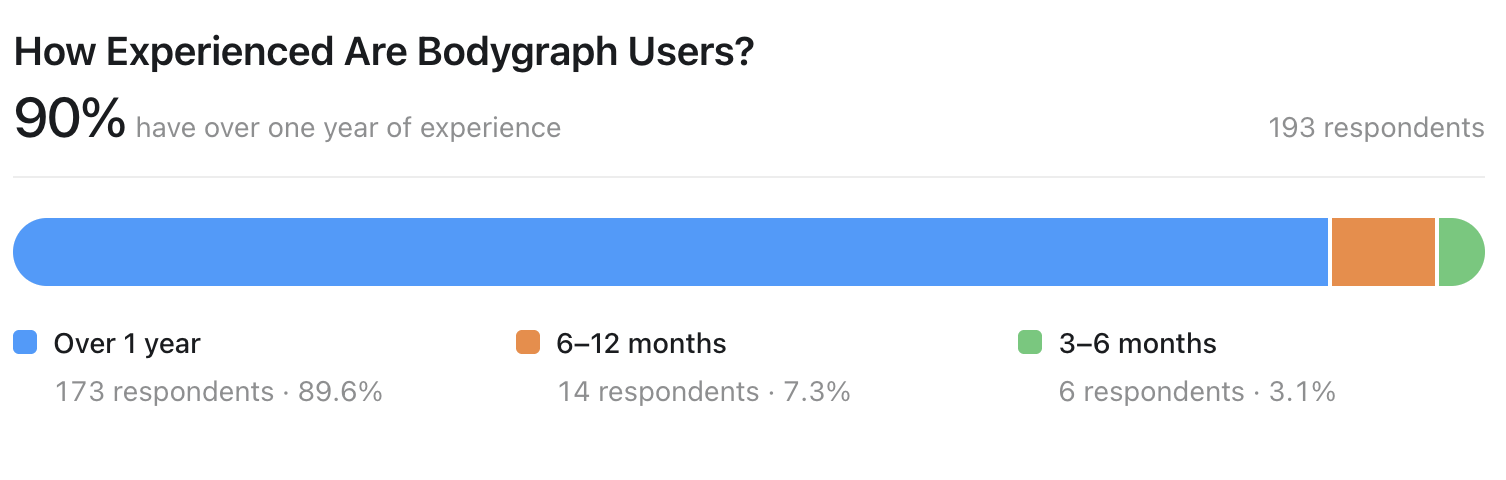
- 174 respondents said they had worked with Human Design for more than one year.
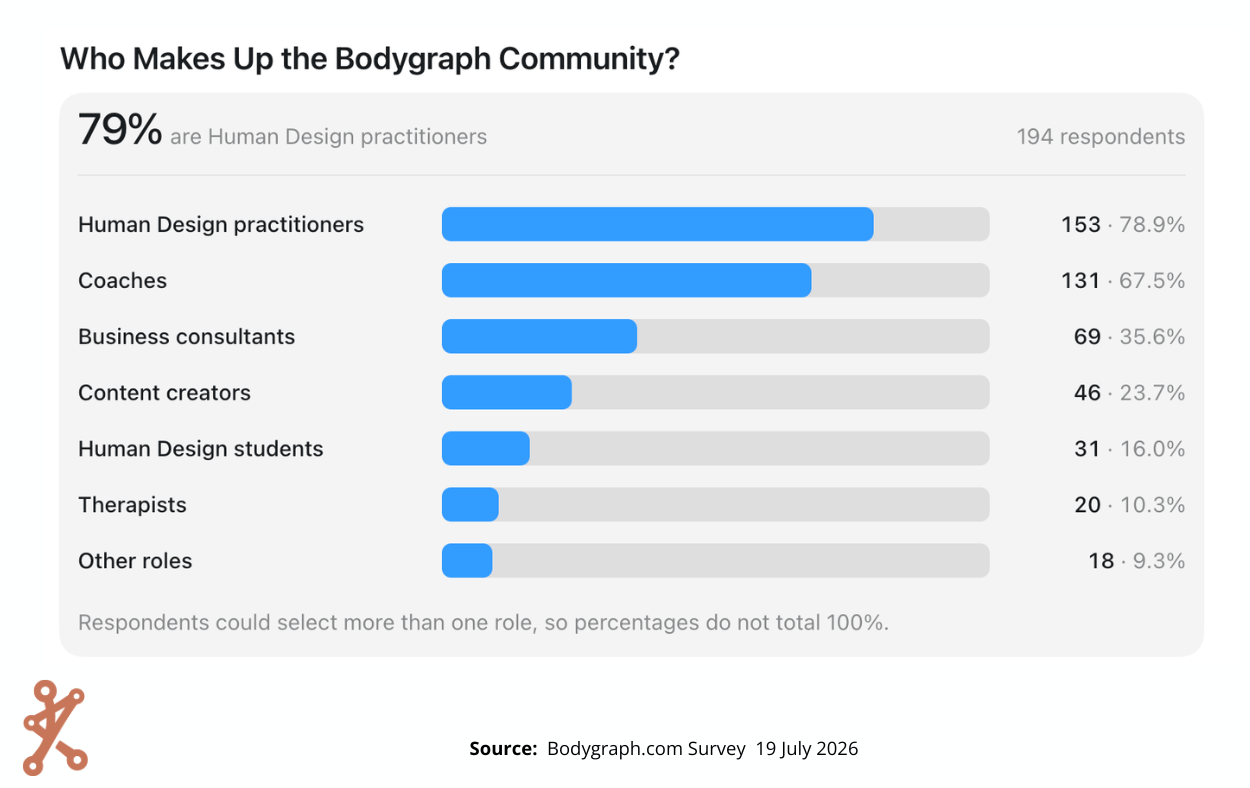
- The audience included Human Design practitioners, coaches, consultants, content creators, therapists and students.
- Common reasons for joining included chart customisation, website embeds, personalised reports and lead magnets.
- Some respondents wanted to keep visitors on their own websites instead of sending them to an external chart platform.
- One respondent specifically mentioned combining astrology and Human Design in a reading or report.
- External research found that 30% of American adults consult astrology, tarot cards or fortune tellers at least annually.
- Only 1% said they rely heavily on these practices when making major life decisions.
What Is Bodygraph?
Bodygraph is a professional Human Design and astrology software platform. It helps practitioners create charts, prepare personalised reports and incorporate chart-based experiences into their websites and client services.
The platform sits at the intersection of four areas:
- Human Design chart generation.
- Personalised reports and readings.
- Website-based client experiences.
- Business, marketing and lead-generation workflows.
This combination means Bodygraph can serve both individuals interested in self-discovery and professionals building services around Human Design or astrology.
Who Is Bodygraph For?
Bodygraph is primarily for people and businesses that want to turn Human Design or astrology information into a personalised experience.
Its main customer groups include:
- Human Design practitioners delivering charts and readings.
- Astrologers creating personalised client experiences.
- Coaches incorporating Human Design into their services.
- Consultants using charts in client conversations.
- Content creators developing personalised digital products.
- Educators teaching Human Design or astrology.
- Practitioner-led businesses generating leads through their websites.
- Students developing their knowledge of Human Design.
The survey indicates that many Bodygraph users belong to more than one category. A Human Design practitioner may also be a coach, consultant, educator and content creator.
What Does the Bodygraph Customer Survey Show?
The latest supplied survey snapshot contained 194 responses to at least one question. Earlier survey screenshots showed 193 responses, suggesting that the survey remained active and received an additional submission.
The respondent mix included Human Design practitioners, coaches, business consultants, content creators, therapists and students.
This diversity indicates that Bodygraph is not limited to a single professional category. It serves people who apply Human Design and astrology in different commercial, educational and client-facing contexts.
Because the survey was conducted among Bodygraph users, it should be treated as first-party customer research rather than a representative study of the entire Human Design market.
How Experienced Are Bodygraph Users?
Experience was one of the clearest findings in the survey.
In the latest supplied snapshot, 174 respondents said they had worked with Human Design for more than one year. This means the majority of the surveyed audience was not encountering Human Design for the first time.
Experienced users are more likely to understand the practical work involved in:
- Generating and interpreting charts.
- Preparing for client readings.
- Explaining complex chart information.
- Creating personalised written materials.
- Managing chart information for multiple clients.
- Presenting Human Design professionally.
This matters when evaluating product-market fit. The survey reflects the needs of people who have spent meaningful time working with Human Design and understand the limitations of manual or disconnected workflows.
Why Do Customers Sign Up for Bodygraph?
The open-text survey responses reveal several recurring motivations.
Creating Customised Charts
Respondents mentioned wanting greater control over how charts look and how chart information is presented.
For a professional practitioner, customisation can help create a consistent brand experience. Instead of giving every client a generic-looking chart, the practitioner can present material that feels connected to their own service and identity.
Embedding Charts on a Website
Website embedding was another important use case in the survey responses.
A practitioner may want visitors to generate a chart without leaving the practitioner’s website. Keeping the experience on-site can create a more coherent customer journey and reduce the need to direct potential clients to a third-party platform.
Creating Personalised Reports
Reports were a recurring reason for using Bodygraph.
A personalised report can accompany a live reading, provide a reference after a session or become a standalone digital product. Reports also help practitioners organise complex chart information into a format clients can read at their own pace.
Building Lead Magnets
Some respondents wanted to use charts or personalised content as lead magnets.
A chart-based lead magnet gives a visitor something individually relevant in exchange for beginning a relationship with the practitioner’s brand. This is different from offering the same general PDF to every visitor.
Combining Human Design and Astrology
One survey response specifically mentioned creating a combined astrology and Human Design reading or report.
This suggests an additional audience for hybrid personalised experiences. Some practitioners work across more than one self-discovery discipline and want their client materials to reflect that broader methodology.
Who Is the Ideal B2C Bodygraph Customer?
In a B2C context, the customer may be an individual practitioner, student or creator purchasing Bodygraph for their own work.
The strongest B2C customer profile is likely to be someone who:
- Already studies or works with Human Design or astrology.
- Wants to create personalised charts or reports.
- Offers individual readings or coaching sessions.
- Creates educational or self-development content.
- Wants a more professional client experience.
- Needs to reduce repetitive chart and report preparation.
- Wants to build an audience through personalised content.
Independent astrology research offers context about the wider audience, although it does not measure Human Design customers directly.
A 2025 Pew Research Center study found that 43% of American women aged 18 to 49 believe in astrology. It also found that 46% of women in this age group consult astrology or horoscopes at least once a year.
The same research found particularly high engagement among LGBT adults: 54% consult astrology or horoscopes at least annually.
These statistics suggest that younger women and LGBT adults are important audiences within the broader astrology and self-discovery market. They should not, however, be presented as a verified demographic profile of Bodygraph customers without direct Bodygraph demographic research.
Who Is the Ideal B2B Bodygraph Customer?
The strongest B2B customer is a practitioner-led business that wants to integrate personalised chart experiences into its commercial workflow.
This may include:
- A Human Design practice serving individual clients.
- A coaching company using Human Design in its programmes.
- A consultant incorporating charts into client work.
- An educator selling courses or training.
- A content creator monetising an established audience.
- An astrology or Human Design brand selling reports.
- A business using personalised charts for lead generation.
For these customers, the buying decision is not based only on personal curiosity. The product must provide practical business value.
A B2B buyer is more likely to ask:
- Will this improve the experience I provide to clients?
- Can it save time when creating charts or reports?
- Can I integrate it into my website?
- Can it help me generate or qualify leads?
- Can I maintain a consistent brand experience?
- Can it support a repeatable paid offer?
B2C and B2B Bodygraph Customers Compared
| Customer need | B2C use | B2B use |
|---|---|---|
| Main objective | Self-discovery or individual professional work | Revenue, lead generation and client delivery |
| Primary user | Individual, student or practitioner | Practice, coaching business, educator or brand |
| Core experience | Personalised chart or reading | Embedded charts, reports and repeatable workflows |
| Main motivation | Curiosity, learning and personalisation | Efficiency, branding and business utility |
| Common question | Is this relevant and accurate for me? | Will this help me serve clients or grow my business? |
| Measure of value | Quality of personal insight | Time saved, leads generated and client experience |
How Large Is the Wider Audience?
Reliable independent research measuring Human Design adoption remains limited. Astrology offers the closest well-researched comparison, but the two should not be treated as identical.
Pew Research Center surveyed 9,593 American adults and found that:
- 27% believe in astrology.
- 28% consult astrology or a horoscope at least annually.
- 30% consult astrology, tarot cards or fortune tellers at least annually.
- 20% participate mainly for fun.
- 10% participate mainly because they find the insights helpful.
- Only 1% rely heavily on these practices for major life decisions.
Source: Pew Research Center: Astrology, Tarot Cards or Fortune Tellers Used by 30% of Americans.
The distinction between belief and use is important. A person does not necessarily need to accept every claim associated with astrology or Human Design to explore a chart or use it for reflection.
The addressable audience may therefore include people who are curious, not only those who identify as committed believers.
What About People Who Are Sceptical?
A 2022 YouGov poll found that 27% of American adults believed in astrology, while 51% did not and 22% were unsure.
Source: YouGov: One in Four Americans Say They Believe in Astrology.
This sceptical audience should not be ignored. It highlights the importance of responsible communication.
Human Design and astrology are better positioned as tools for reflection and personal exploration than as scientifically validated methods or guaranteed predictors of outcomes.
Practitioners can build trust by:
- Avoiding absolute or unverifiable promises.
- Explaining what a chart can and cannot provide.
- Presenting insights as invitations for reflection.
- Respecting the client’s own judgment and experience.
- Avoiding medical, psychological, financial or legal claims.
- Being transparent about their methodology.
Bodygraph Compared With Manual Workflows
| Area | Manual workflow | Bodygraph-supported workflow |
|---|---|---|
| Chart creation | Information may be moved between separate tools | Charts can be incorporated into a connected workflow |
| Report preparation | Content may be assembled repeatedly for each client | Reusable report processes can reduce repetitive work |
| Website experience | Visitors may be sent to another platform | Charts can be presented within the practitioner’s website |
| Lead generation | Generic forms or downloadable PDFs | Personalised chart experiences can support lead magnets |
| Brand consistency | Materials may come from disconnected systems | Client-facing content can remain closer to the practitioner’s brand |
| Scaling | More customers may create proportionally more preparation | Repeatable processes may help practitioners serve more clients |
Bodygraph Compared With Generic Personality Tools
Generic personality tools can help people explore traits, preferences or working styles. Bodygraph serves a more specialised audience interested in Human Design, astrology and birth-data-based personalisation.
The key distinction is not that one approach is universally better. The difference lies in the intended customer and use case.
- Generic personality tools target broad personal or workplace assessment needs.
- Human Design tools target audiences specifically interested in Bodygraph charts and related interpretations.
- Bodygraph’s professional use cases include website integration, client reports and practitioner-led offers.
What Makes Bodygraph Valuable to a Practitioner-Led Business?
The survey suggests that Bodygraph creates the most value when it helps practitioners turn specialist knowledge into a consistent client experience.
That value may come from:
- Reducing repetitive preparation.
- Creating personalised client materials.
- Keeping chart experiences within the practitioner’s website.
- Supporting lead-generation campaigns.
- Presenting a more consistent brand.
- Developing repeatable paid products.
- Combining Human Design and astrology in one client journey.
Technology does not replace the expertise of a practitioner. Its role is to support the operational parts of the service so the practitioner can focus on interpretation, communication and client relationships.
Is the Human Design Market Growing?
There is visible commercial and online interest in Human Design, but independent market-size research remains thin.
One Bodygraph industry analysis estimates that the Human Design market may generate approximately $100 million to $500 million annually. This is a broad company estimate rather than an independently established market valuation, so it should be treated as directional rather than definitive.
Source: Bodygraph Human Design market estimate.
A more defensible conclusion is that the surrounding audience is measurable. Astrology research shows substantial participation in adjacent practices, while Bodygraph’s own survey demonstrates demand from experienced Human Design professionals.
Is Bodygraph Only for Human Design Practitioners?
No. Human Design practitioners are an important customer group, but the survey also included coaches, consultants, content creators, therapists and students.
Bodygraph may be relevant to anyone who wants to create professional Human Design or astrology charts, reports or personalised website experiences.
However, the product is likely to provide the most commercial value to people who already have—or plan to build—an audience, client service or educational offer.
Is Bodygraph a B2C or B2B Platform?
Bodygraph can serve both markets.
It is B2C when an individual practitioner, student or creator purchases it for personal professional use. It becomes B2B when a practice, coaching company, education provider or digital brand integrates it into a broader customer journey.
The same chart technology can therefore support different goals:
- Personal exploration.
- Professional readings.
- Client reports.
- Website engagement.
- Lead generation.
- Digital product sales.
Frequently Asked Questions
Who is the ideal Bodygraph customer?
The ideal customer is a Human Design practitioner, astrologer, coach, consultant, creator or practitioner-led business that wants to create personalised charts, reports or website experiences.
Why do practitioners use Bodygraph?
Survey respondents mentioned chart customisation, website embedding, report generation, lead magnets and keeping clients within their own branded website experience.
Can Bodygraph be used for lead generation?
Yes. Practitioners can use personalised chart experiences as lead magnets that encourage website visitors to begin a relationship with their brand.
Can Bodygraph support both Human Design and astrology?
Bodygraph operates across Human Design and astrology use cases. Survey feedback also included interest in combining the two within a reading or report.
Is Bodygraph suitable for beginners?
Students were represented in the customer survey, but the largest practical value may be experienced by people actively creating charts, reports or professional client services.
Does Bodygraph replace a Human Design practitioner?
No. Software can support chart generation and report workflows, but the practitioner remains responsible for interpretation, context, communication and the client relationship.
How many people responded to the Bodygraph survey?
The latest supplied snapshot recorded 194 responses to at least one survey question. An earlier screenshot showed 193 responses, indicating that an additional response may have arrived while the survey remained active.
Research Methodology and Limitations
The Bodygraph findings come from an internal customer survey. They describe participating Bodygraph users and should not be generalised to the entire Human Design or astrology market.
Open-text answers were analysed as anonymous themes. Names, email addresses and other identifying details should not be published.
Response totals may vary between questions because participants may skip individual questions, select more than one answer or respond while the survey remains active.
The external market context comes primarily from Pew Research Center’s nationally representative survey of 9,593 American adults, conducted in October 2024 and published in May 2025.
The Pew and YouGov studies measured astrology and related practices rather than Human Design. They are included as adjacent audience research and should not be presented as direct measurements of Human Design adoption.
The Human Design market-size