Is the Human Design market saturated? The available evidence suggests that it is not. Human Design has become more visible and competitive, but it remains a relatively small and developing industry compared with astrology.
There may be many Human Design practitioners, chart websites, courses and social media accounts competing for the attention of people who already understand the system. However, competition within an existing community is not the same as saturation across the wider consumer market.
Human Design still has relatively low public awareness. Many people have never heard of it, while others have generated a chart but do not understand how to use it. This creates opportunities for businesses that make Human Design more accessible, practical and relevant to specific audiences.
Is the Human Design Market Saturated?
No, the available evidence does not suggest that the Human Design market is saturated. It is more accurate to say that certain parts of the market, particularly generic readings and introductory content, are becoming crowded.
A saturated market normally has several characteristics:
- Most potential customers already understand the category.
- Customer demand has stopped growing.
- Products have become difficult to distinguish from one another.
- Most potential customers already use a competing product.
- Acquiring new customers has become consistently unprofitable.
Human Design does not yet meet these conditions as a complete industry. Awareness is still limited, the market remains fragmented and new applications continue to emerge.
Astrology Shows the Potential Size of the Market
Human Design and astrology are separate systems, but they operate in closely related industries. Both use birth information to generate personalised interpretations, and both are connected with identity, relationships, decision-making and personal development.
Astrology therefore provides a useful reference market for understanding the potential direction of Human Design.
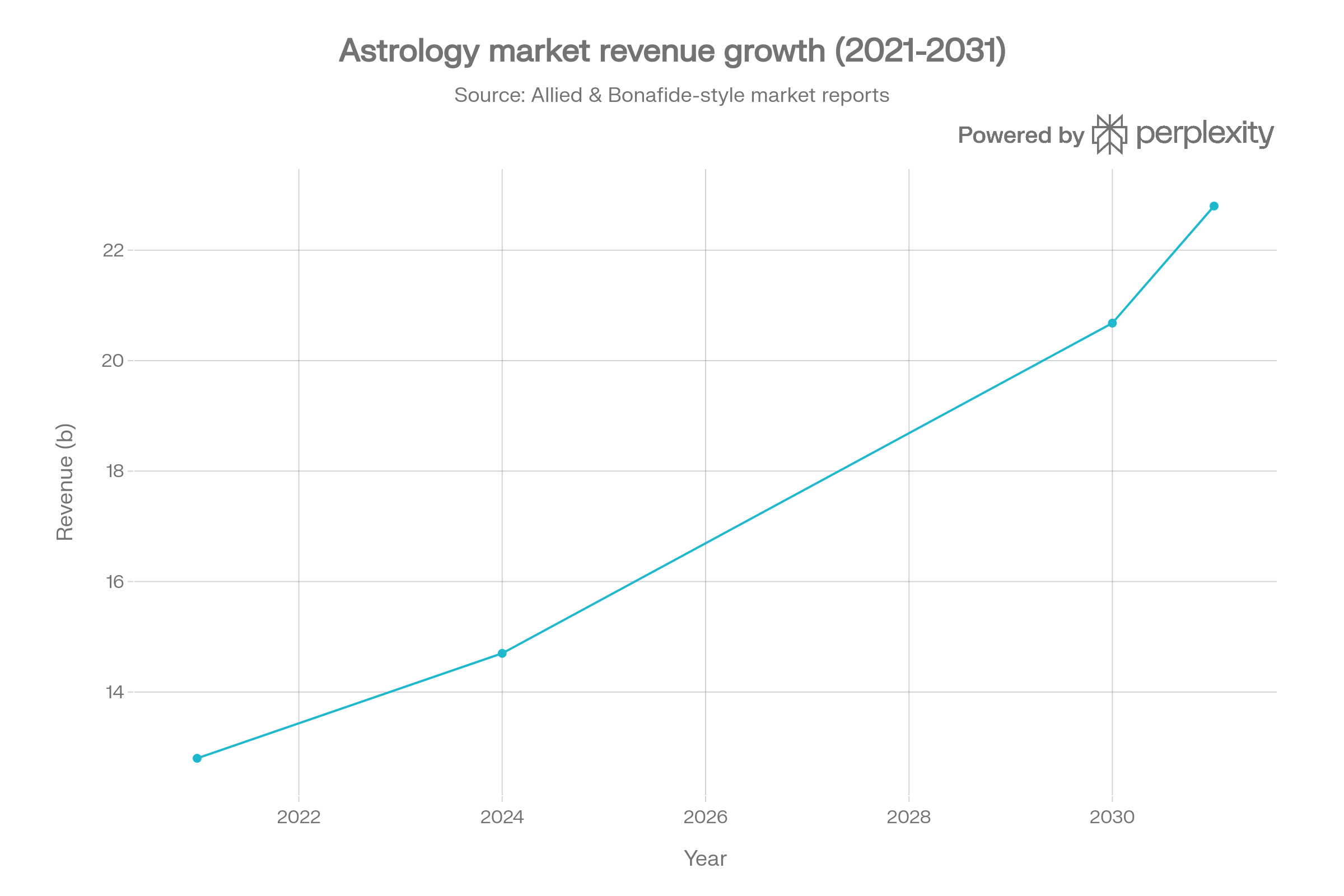
Allied Market Research estimated that the global astrology market was worth approximately $12.8 billion in 2021. It forecast that the market could reach approximately $22.8 billion by 2031.
These figures cover more than astrology apps. Depending on the research methodology, the wider astrology industry may include personal consultations, digital reports, educational programmes, media, software, subscriptions and other services.
Consumer Interest in Astrology
A nationally representative Pew Research Center survey of 9,593 adults in the United States found significant consumer participation in astrology and related practices.
- 30% consult astrology, tarot cards or fortune tellers at least once a year.
- 28% consult astrology or a horoscope at least annually.
- 27% say they believe in astrology.
- 43% of women aged 18 to 49 say they believe in astrology.
- 54% of LGBT adults consult astrology or a horoscope at least annually.
These statistics do not prove the scientific validity of astrology or Human Design. They demonstrate something commercially important: a substantial number of people are interested in personalised systems for self-understanding, reflection and guidance.
Astrology has already normalised the experience of entering birth information and receiving a personalised interpretation. Human Design does not need to create this consumer behaviour from nothing.
Astrology Apps Demonstrate Digital Demand
Commercial market forecasts suggest that astrology has also developed a significant digital economy.
One commercial forecast valued the global astrology app market at approximately $3 billion in 2024 and projected that it could reach $9 billion by 2030. Another report used a narrower definition and estimated a market size of approximately $150 million in 2024, increasing to $291 million by 2030.
The large difference between these estimates demonstrates why market statistics must be treated carefully.
Some reports may include web payments, live consultations, advertising, tarot, numerology and related services. Others may count only revenue generated directly through astrology apps.
The most reliable conclusion is not that one precise figure must be correct. The evidence shows that astrology supports a substantial digital industry and that commercial analysts expect this industry to continue growing.
How Big Is the Human Design Market?
There is currently no independent and widely accepted study measuring the total size of the global Human Design market.
A working estimate of between $100 million and $500 million in annual economic activity may be plausible when practitioner services, education, software, reports, memberships and digital products are considered together.
However, this figure should be described as a Bodygraph working estimate rather than an independently verified market statistic.
Even at the top of this estimated range, Human Design would remain considerably smaller than astrology. That size difference does not guarantee that Human Design will become as large as astrology, but it shows that the category has room to develop before approaching the scale of its closest reference market.
What Bodygraph Data Shows About Human Design Growth
Bodygraph’s aggregated platform data provides a direct view of activity within part of the Human Design industry.
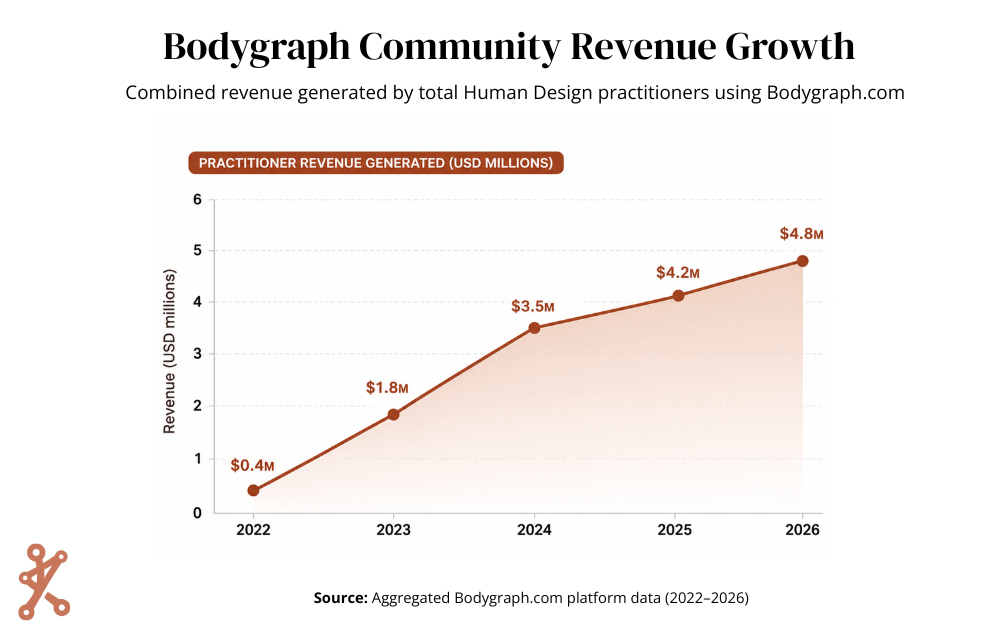
At the time of publication, Bodygraph reports the following platform statistics:
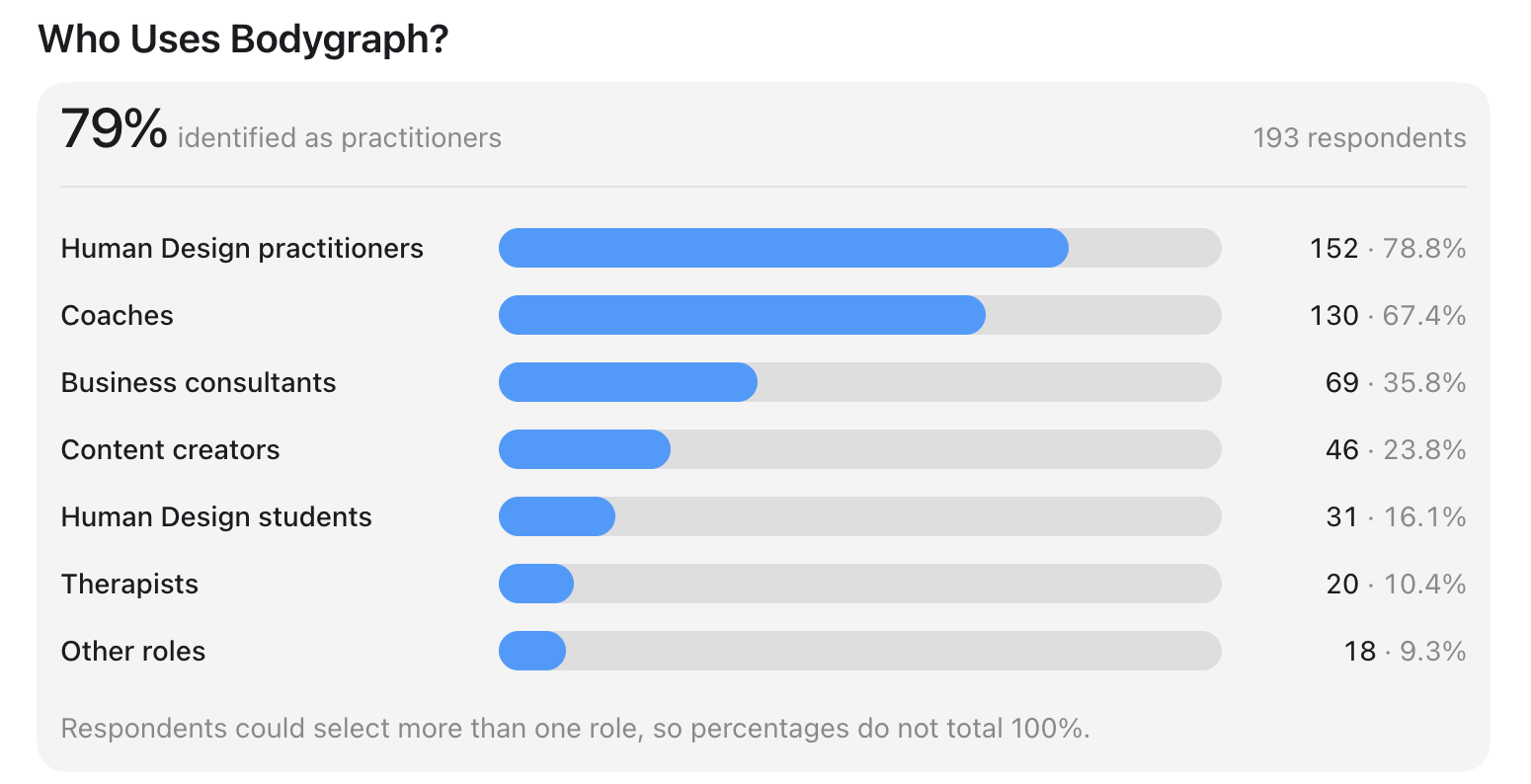
- More than 2,000 Human Design practitioners supported.
- Customers operating across 55 countries.
- More than 4 million Human Design chart calculations per month.
- More than 18,000 personalised Reading Reports created.
- More than $4.8 million in practitioner revenue generated using Bodygraph tools.
These figures describe activity on one platform. They do not represent the entire Human Design market and should not be directly extrapolated into a global market valuation.
Nevertheless, they provide evidence that Human Design already supports international usage, digital product creation and real commercial activity.
Why Human Design Can Appear Saturated
Human Design can feel saturated to people who already work inside the industry. Practitioners frequently see other practitioners, courses, chart websites and social media content.
Online platforms can intensify this impression. Their recommendation systems repeatedly show users content related to subjects they already follow. A Human Design practitioner may therefore see Human Design content every day and conclude that the entire market is crowded.
The potential customer often sees something very different.
Many people still do not know what Human Design is. Others have encountered the system but find its terminology complicated. Some generate a chart, read a basic description and never develop an ongoing practice.
The distance between generating a Human Design chart and applying Human Design in everyday life remains significant. Businesses that help customers cross that gap may still have substantial opportunities.
Competition Is Not the Same as Market Saturation
The Human Design industry has competition, but competition can be evidence of demand. A market with no competitors may also be a market with no customers.
The more important question is where competition is concentrated.
The most crowded areas of Human Design commonly include:
- Generic chart calculators.
- Basic descriptions of Types and Authorities.
- General introductory readings.
- Social media content that repeats familiar information.
- Offers without a clearly defined audience or outcome.
The less-developed opportunities involve practical applications, distinctive customer experiences and services designed for particular audiences.
Human Design Is Growing in Multiple Directions
Human Design is not a single market. It is developing into an ecosystem with several related branches.
Personal Self-Understanding
Personal self-understanding remains the most common entry point. Consumers want to understand their Type, Strategy, Authority, Profile and other chart elements.
Potential products include interactive charts, personalised reports, guided learning programmes, journals and practical tools that help users apply information over time.
Relationships and Families
Human Design can be developed into products and services for couples, parents and families.
Instead of interpreting one chart in isolation, these services can explore communication preferences, emotional dynamics, decision-making and differences between family members.
Coaching and Professional Services
Coaches can incorporate Human Design into career, leadership, relationship, wellness or business programmes.
The opportunity is not limited to selling a chart reading. Human Design can become one component within a more clearly defined coaching experience or customer transformation.
Education and Practitioner Training
Growing interest creates demand for structured education. This can include introductory courses, advanced programmes, practitioner training, certification and continuing professional development.
Clear educational standards, ethical communication and quality assurance will become increasingly important as this part of the Human Design industry develops.
Digital Products and Memberships
Human Design practitioners are expanding beyond one-to-one readings into digital reports, courses, memberships, subscriptions and automated learning experiences.
These products can create recurring revenue and allow practitioners to serve more customers without connecting every sale to another hour of work.
Human Design Software and APIs
Technology represents another direction for Human Design market growth.
Potential opportunities include practitioner platforms, chart calculators, automated reports, client portals, mobile applications and Human Design APIs that allow developers to add chart functionality to other products.
AI-Assisted Human Design Experiences
Artificial intelligence can help explain complex chart information, personalise educational content and support interactive customer experiences.
AI also creates risks involving accuracy, privacy, oversimplification and responsible communication. Trustworthy Human Design products should use transparent calculations, protect birth information and provide appropriate human oversight.
Business and Organisational Applications
Some practitioners are exploring Human Design in leadership development, entrepreneurship, team communication and workplace wellbeing.
This area requires particular care. Human Design should not be presented as a scientifically validated method for predicting employee performance or making high-stakes recruitment decisions.
A more responsible application is to use Human Design as an optional framework for reflection and conversation.
Which Parts of the Human Design Market Are Saturated?
The entire Human Design market may not be saturated, but individual types of offers can become crowded.
A Human Design product may struggle when it has:
- No clearly defined audience.
- No specific customer problem to address.
- The same language and positioning as competing products.
- A large amount of information but little practical application.
- No evidence of customer outcomes or satisfaction.
- No continuing experience after the initial chart or reading.
- No clear reason for customers to trust the provider.
Creating another generic Human Design reading may therefore be difficult. Creating a trusted solution for a specific audience can be a very different opportunity.
Where Are the Human Design Business Opportunities?
The strongest opportunities are likely to come from making Human Design more useful, accessible and relevant.
Potential Human Design business opportunities include:
- Decision-making tools for entrepreneurs.
- Communication programmes for couples.
- Practical Human Design support for parents.
- Structured education for beginners.
- Professional software for practitioners.
- Personalised digital reports.
- Memberships and continuing learning experiences.
- Human Design tools for coaches.
- Privacy-conscious AI interpretation.
- Human Design APIs for developers and digital platforms.
The key is specificity. Businesses should identify a particular audience, a clear problem and a useful outcome rather than attempting to serve everyone interested in Human Design.
Is Human Design Becoming More Popular?
Bodygraph platform activity suggests that Human Design is being used internationally and that practitioners are building real businesses around it.
However, no independent global study currently measures total Human Design awareness or its rate of adoption. Claims about its popularity should therefore distinguish between observable platform activity and estimates about the complete market.
The wider environment may support continued development. Consumers are already familiar with personalised digital experiences, astrology apps, online coaching, subscriptions and self-awareness content. Human Design can participate in these established behaviours while developing its own market identity.
Will Human Design Become as Big as Astrology?
There is not enough evidence to predict that Human Design will become as large as astrology.
Astrology has greater public awareness, a longer cultural history and a much larger commercial ecosystem. Human Design remains smaller and more dependent on practitioners, education and specialised communities.
Human Design does not need to become as large as astrology to support successful businesses. A smaller international market can still create significant opportunities for practitioners, educators, software companies and specialised service providers.
What Is the Future of the Human Design Industry?
The future of the Human Design industry is likely to involve a combination of personal services and scalable technology.
One-to-one readings will remain important, but practitioners are also developing reports, courses, communities, subscriptions and automated customer experiences.
Software and AI may make personalised information easier to access. At the same time, human guidance, accuracy, privacy and trust may become more valuable as the amount of automatically generated content increases.
The businesses most likely to stand out will be those that combine credible expertise with clear communication, responsible technology and practical customer value.
Conclusion: Is the Human Design Market Saturated?
Is the Human Design market saturated? The evidence suggests that the answer is no.
Some generic offers are becoming crowded, and practitioners face more competition for customers who already understand Human Design. However, the wider category remains considerably smaller and less mature than astrology.
Human Design has moved beyond being a small study community, but it has not yet become a mature mass-market industry. Public awareness remains limited, the market is fragmented and several potential applications are still developing.
The opportunity is not simply to create another chart, reading or introductory course. The opportunity is to make Human Design clearer, more practical and more valuable for a specific group of people.
The Human Design market is not full. It is still deciding what it will become.
Research Methodology and Limitations
This market analysis combines independent consumer survey data, published commercial forecasts and aggregated Bodygraph platform statistics.
Commercial market reports use different definitions and should not be treated as though they measure identical products or revenue sources. The estimated size of the Human Design market is a Bodygraph working scenario because no independent global Human Design market study is currently available.
Bodygraph statistics describe activity within one platform. They do not represent the entire Human Design industry.
This article evaluates consumer participation, market development and business activity. It does not claim that astrology or Human Design has scientifically established predictive validity.
Sources
- Pew Research Center: 30% of Americans Consult Astrology, Tarot Cards or Fortune Tellers, published in 2025.
- Allied Market Research: Astrology Market Research, Global Opportunity Analysis and Industry Forecast.
- TIME: How Astrologers Prepared for the 2024 Solar Eclipse.
- MarkNtel Advisors: Global Astrology App Market Forecast for 2025–2030.
- Bodygraph aggregated platform statistics and internal market analysis.